
The Needs Community in Bürgergeld
The Needs Community in Bürgergeld
The concept of the “needs community” (Bedarfsgemeinschaft) is central to understanding the Bürgergeld system. Unlike many other social benefits, Bürgergeld does not only consider the individual situation, but the joint economic situation of all persons who live together in a household and “economize from one pot”. This article explains what a needs community is, who belongs to it, and what consequences result from this.
What is a Needs Community?
A needs community is a community of persons who live together in a household and whose income and assets are considered together when calculating the Bürgergeld entitlement. The basic principle is: Persons who live together and (can) stand up for each other must do so before state benefits can be claimed.
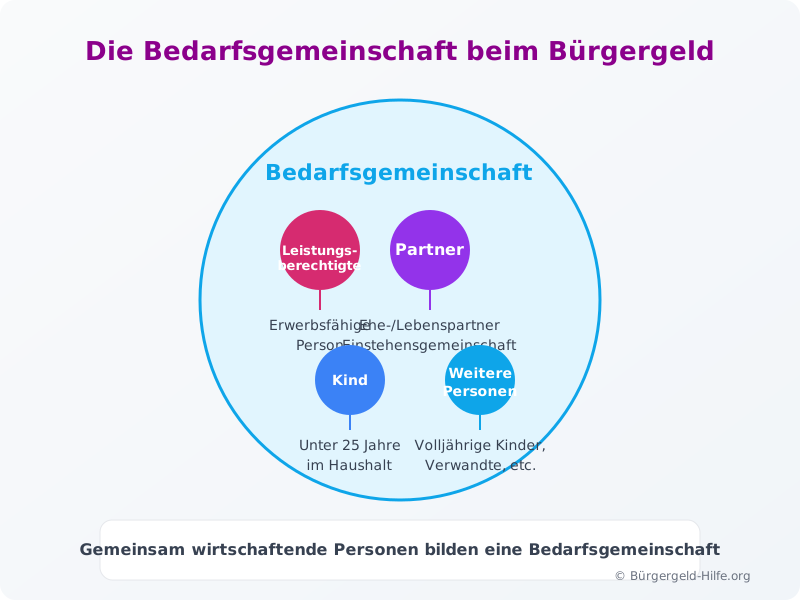
Who Belongs to the Needs Community?
The following persons can belong to the needs community:
1. The Employable Person Entitled to Benefits Themselves
The person who is basically able to work at least three hours per day and whose need for assistance is being examined.
2. Partner of the Person Entitled to Benefits
This includes:
- Spouse (not permanently separated)
- Registered life partner (not permanently separated)
- Partner in a “responsibility and mutual support community” (marriage-like community)
What is a “Responsibility and Mutual Support Community”?
Such a community exists when:
- Partners have lived together for more than one year, or
- Live together with a common child, or
- Care for children or relatives in the household together, or
- Are authorized to dispose of the other’s income or assets
Mutual responsibility is assumed when there are indicators such as common children, common property, or a longer-term relationship. The job center can request further evidence in case of doubt.
3. Children in the Household
Unmarried children under 25 years of age belong to their parents’ needs community if:
- They live in the same household and
- They cannot support themselves from their own income or assets
As soon as a child turns 25 or marries, they form their own needs community, even if they continue to live in the parental home.
4. Parents or Parent of a Minor, Unmarried Employable Child
If an unmarried child under 25 years of age lives with their parents or one parent and applies for Bürgergeld, the parents (parent) living in the household belong to the child’s needs community.
Who Does NOT Belong to the Needs Community
The following persons in the household do not belong to the needs community:
- Relatives and in-laws (except parents, children under 25 years)
- Roommates in shared accommodation without a partnership relationship
- Subtenants
- Adult children from 25 years of age
- Grandparents and grandchildren
- Children temporarily living in the household for care
- Persons who exclusively receive benefits under SGB XII
- Foster children and foster parents
The Difference Between Needs Community, Household Community, and Shared Accommodation
Needs Community
As described above: Persons who live in a common household and manage together (family in the narrow sense).
Household Community
Relatives or in-laws who live together in a household but do not belong to the needs community (e.g., grandparents, adult siblings over 25 years). Here it is assumed that they financially support each other (rebuttable presumption).
Shared Accommodation
Persons who only share accommodation costs but otherwise manage separately (e.g., typical student shared accommodation). Here no mutual support is assumed, each forms their own needs community.
Impact on Benefit Entitlement
Membership in the needs community has significant impact on benefit entitlement:
1. Joint Needs Calculation
The needs of all members are calculated together. The following standard rates apply (as of March 2025):
| Person Group | Standard Rate |
|---|---|
| Single persons/Single parents | 563 € |
| Adult partners within a needs community | 506 € |
| Adults 18-24 years in parental household | 451 € |
| Adolescents 14-17 years | 471 € |
| Children 6-13 years | 390 € |
| Children 0-5 years | 357 € |
2. Mutual Income and Asset Calculation
The income and assets of all members of the needs community are added together and compared to the total needs.
Example: A family of four with two children (7 and 15 years) has a total need of:
- 506 € + 506 € + 390 € + 471 € = 1,873 € plus housing costs
If one parent earns 1,500 € net, this income (after deduction of allowances) is offset against the total needs.
3. Mutual Maintenance Obligations
Within the needs community, it is expected that members stand up for each other before state benefits can be claimed. For detailed information on maintenance obligations and their calculation, you will find comprehensive guides and free calculators on our partner portal SmartUnterhalt.
Special Case Scenarios
1. Temporary Absence
Even with temporary absence (e.g., hospital stay, temporary imprisonment), one remains part of the needs community as long as the absence is not permanent.
2. Visitation Rights and Separated Parents
With separated parents with joint visitation rights, the child belongs to the needs community of the parent with whom they primarily live. With equal residence (alternating model), a division of benefits can occur.
3. Adult Children Under 25 Years
For this group, there are special regulations when moving out of the parental home. A move must generally be approved by the job center if benefits are to continue to be received.
Practical Tips
-
Documentation of Living Conditions: In case of doubt about membership in the needs community, it is helpful to document the actual living conditions (separate accounts, separate purchases, etc.).
-
Report Changes: Changes in the composition of the needs community (e.g., moving out, moving in, birth of a child, separation) must be reported to the job center immediately.
-
Special Hardship Cases: In certain situations (e.g., domestic violence), exceptions from the calculation of partner income can be requested.
-
Refuting the Presumption of a Mutual Support Community: Anyone who lives with a partner but does not form a “responsibility and mutual support community” must prove this if necessary (e.g., through separate accounts, no joint purchases).
Conclusion
The concept of the needs community is a fundamental principle of the Bürgergeld system and is based on the assumption that people who live together in family relationships economically stand up for each other before state support is claimed. It is important to correctly classify one’s own situation, as this can have significant impact on benefit entitlement.
In case of doubt, consultation with an independent social counseling center or a specialist lawyer for social law is recommended, as the distinction between the different forms of community is often complex and requires individual case consideration.
Note: The information presented corresponds to the status as of March 2025. Legal changes are possible at any time.