
Income and Asset Limits in Bürgergeld
Income and Asset Limits in Bürgergeld
A central question in Bürgergeld is: How much can I earn and own to still be entitled? This article provides detailed information on current income and asset limits and explains which allowances apply.
The Grace Period: Special Regulations in the First 12 Months
An important feature of Bürgergeld is the so-called grace period. In the first 12 months of benefit receipt, more generous regulations apply both for assets and housing costs.
Assets During the Grace Period
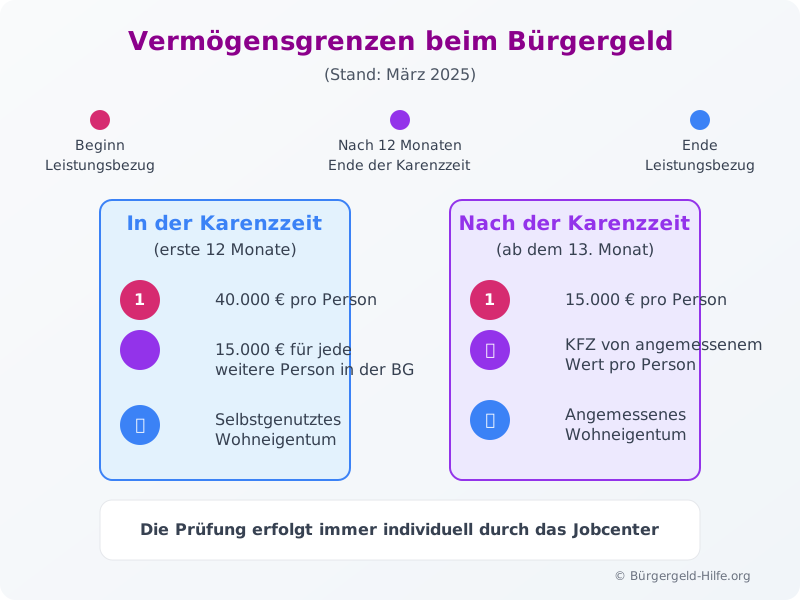
During the grace period, assets are only considered if they are substantial. The following are considered substantial:
- 40,000 € for the first person in the needs community
- 15,000 € for each additional person in the needs community
Example: For a family of four with two adults and two children, the protected assets during the grace period amount to 40,000 € + 3 × 15,000 € = 85,000 €.
Housing Costs During the Grace Period
In the first 12 months, the actual costs of accommodation are recognized, regardless of whether the housing is considered “appropriate” or not. This gives benefit recipients time to focus on their professional situation without immediate relocation pressure.
Asset Limits After the Grace Period
After the 12-month grace period expires, the following asset allowances apply:
- 15,000 € per person in the needs community
This means for a family of four a protected asset of 60,000 €.
What Counts as Assets?
Assets generally include all realizable assets, such as:
- Cash
- Balances on checking, savings, and deposit accounts
- Stocks, securities, funds
- Capital life insurance
- Precious metals
- Jewelry (beyond a reasonable scope)
- Collections of significant value
- Real estate not used for own residence
What Does Not Count as Assets?
The following assets remain exempt:
- Owner-occupied residential property of appropriate size
- Condominium: up to 130 sqm
- Single-family house: up to 140 sqm
- An appropriate motor vehicle per employable person (regardless of value)
- Retirement assets in certain amounts (e.g., Riester pension)
- Household goods in usual scope
- Items needed for starting or continuing vocational training or employment
- Family heirlooms and inheritances, the sale of which would mean particular hardship
- Assets demonstrably intended for the soon acquisition or preservation of an appropriate residential property
Income Limits and Income Calculation
Unlike assets, there is no fixed “limit” for income. Instead, the adjusted income (after deduction of allowances) is compared to the needs of the needs community. If income is lower than needs, there is generally an entitlement to supplementary benefits.
What Counts as Income?
All receipts in money or monetary value are considered as income, including:
- Income from employment
- Unemployment benefit I
- Sickness benefit
- Parental allowance (above the allowance of 300 €)
- Maintenance payments
- Pensions
- Rental and lease income
- Capital income (interest, dividends)
- Tax refunds
From Gross to Calculable Income
Not all gross income is calculated. The following are first deducted:
- Taxes and social security contributions
- Business expenses (lump sum or actual costs)
- Expenses for private insurance (lump sum)
- Allowances (especially for employment income)
Allowances for Employment Income
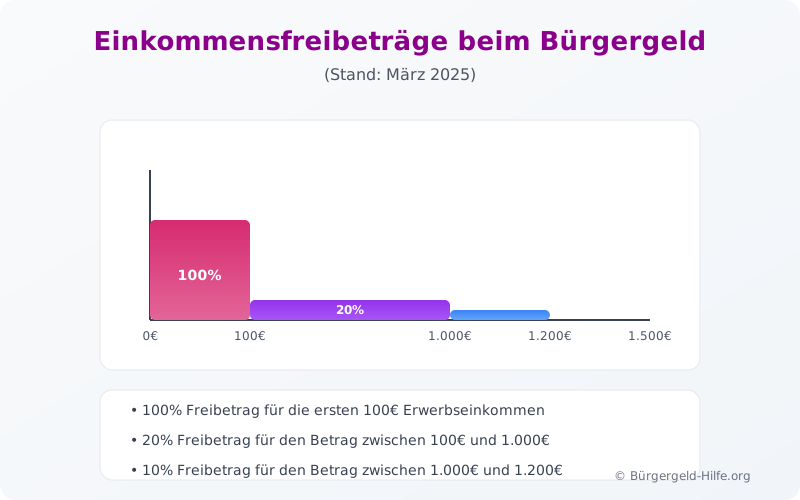
From net income from employment, the following remain exempt:
- The first 100 € in principle
- 20% of net income between 100 € and 1,000 €
- 30% of net income between 1,000 € and 1,200 € (with minor children up to 1,500 €)
Example Calculation: With a net income of 1,300 € for a person with a child:
- 100 € (basic allowance) = 100 €
- 20% of 900 € (range 100-1,000 €) = 180 €
- 30% of 300 € (range 1,000-1,300 €) = 90 €
- Total allowance: 370 €
- Calculable income: 1,300 € - 370 € = 930 €
Special Allowances
- Volunteer lump sum: Income from volunteer work up to 250 € per month
- Expense reimbursements for certain volunteer activities
- Income of students under 25 years from vacation jobs (up to 2,400 € per calendar year)
- Expense reimbursements for trainers, instructors, educators (up to 3,000 € per year)
- Maternity benefit during protection periods
- Basic pension under the Federal Pension Act
- Care allowance for caregivers caring for a relative
Special Types of Income
Maintenance
Maintenance payments are generally calculated as income. However, there is an allowance of 30 € per month for actual expenses (e.g., travel costs) in connection with fulfilling maintenance obligations for children not living in the household.
Self-Employed
For self-employed persons, income is determined based on profit, which results from business income minus necessary business expenses. Since income often fluctuates, a forecast is often used, which is later reconciled with actual income.
Capital Income
Interest, dividends, and other capital income are calculated as income. Costs for managing investments can be deducted.
Conclusion and Practical Tips
The income and asset check in Bürgergeld is complex but offers more scope than the former Hartz IV system through numerous allowances and special regulations. Especially in the first 12 months (grace period), the protection of existing assets has been significantly improved.
Tips for Practice:
- Documentation: Keep a clear overview of your assets and all income sources.
- Use allowances: Inform yourself precisely about all applicable allowances to reduce your calculable income.
- Prove business expenses: With higher actual business expenses, it is worth proving them individually instead of the lump sum.
- Check retirement provision: Assets in recognized retirement forms are better protected.
- Use consultation: In complex cases, consultation with a social counseling center or a specialist lawyer is recommended.
Use our Entitlement Calculator to get an initial assessment of your individual entitlement.
Note: The information presented corresponds to the status as of March 2025. Legal changes can occur at any time. In case of doubt, personal consultation should be sought.